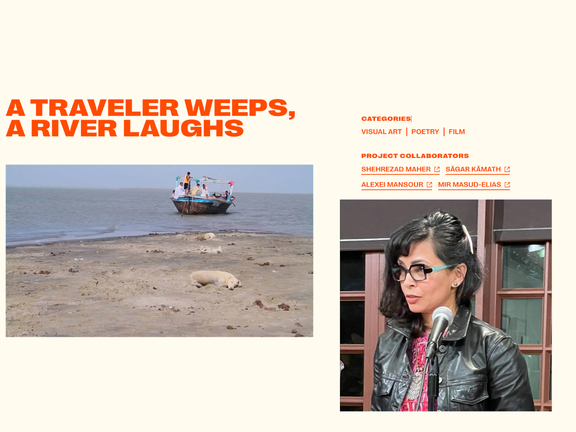
On cultural roots, migration, and community within AAPI spaces and beyond with Mir Masud-Elias
-

-

-


How do your cultural roots, migration stories, or ancestral histories shape the way you move through your work and the world?
I am from Dhaka, Bangladesh — from delta water and monsoon light and a language that blooms differently at night than it does in the day. I am also from Philadelphia, which adopted me and made me a poet. And I am from the in-between: the hyphen, the time difference, the oath taken in a Philadelphia courtroom in 2007 that changed my citizenship but not my questions.
Migration gave me a particular kind of double vision. I move through the world with a body that is bounded and personal — that has a history, a morning routine, a set of losses — and a body that is vast and connected to everything happening everywhere at once. My creative practice lives in the tension between those two scales. I am always trying to write the intimate and the planetary in the same breath, because for me they have never been separate.
Raised Muslim, I am drawn spiritually to mystic traditions away from organized rituals and practice — to the idea that the self is porous, that belonging is not a fixed address but a practice of attention, meditation on the quotidian. That shapes how I write: not toward resolution, but toward openness.
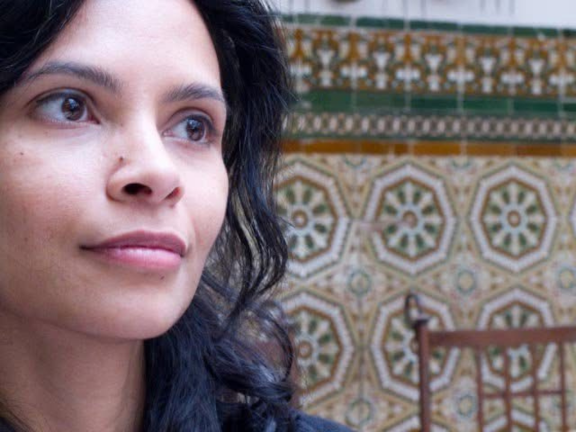
What does community look like to you, especially within AAPI spaces?
Community, for me, is presence that doesn't require you to simplify yourself. It's the room where being South Asian and Muslim and immigrant and lawyer and poet is not a contradiction to manage, but the whole complicated truth of a person — and that's what's welcomed in.
I've found that most in spaces that resist flattening our differences into a single story. The AAPI communities that have held me are the ones willing to sit with complexity: with the grief of languages half-lost, with the discomfort of being both marginalized and complicit, with the fact that solidarity is a practice, not a position.
Twelve Gates Arts in Philadelphia has been that kind of home. I'm also finding community increasingly in the page — in writers who ask hard questions about what it means to belong to a place and a people and a body all at once, and who trust that art can hold those questions without rushing them toward answers. Also, in dance, in music, in film and theater.
Who holds you and who are you in relationship with through your work?
The universe holds me. The web of living things — the fungi threading through forest floors, the birds rerouting their migrations in a warming world, the earthworms surfacing after rain, the whales moving through oceans we've filled with noise — all of it holds me, and not just me. All of us. You too, reading this. That sense of radical belonging to the whole of existence is not just a spiritual position for me; it is the animating force behind the work and the purpose of my existence in this limited human body.
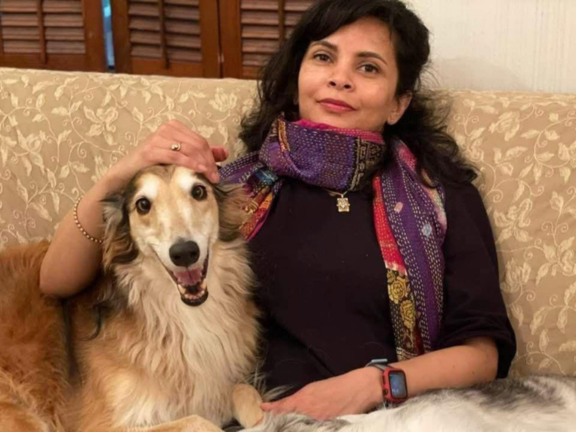
My dogs hold me every single day. They are my greatest teachers in the art of being present. There is nothing conditional about what they offer, and nothing I have to explain. My husband, an artist in his own right, also holds me by offering me the only safe emotional harbor (other than my older sister) in this world. My family of origin has a hold over me as the only connection I have to my past selves, who all seem like distant memories to me now.
In terms of the work itself — the teachers who expanded my sense of what a poem could carry, the poets across generations and languages whose survival on the page gave me permission to try, the editors (such as, Divya Victor) and readers (some of my fellow students in poetry workshops) who met the work with rigor and love — they are in the room with me when I write. And the writers I haven't met, whose books found me at exactly the right moment: they hold me too. I am also shaped by the near-rhymes and internal music of politicized rap — the way it bends language toward feeling without breaking it, the way it finds the slant truth in the almost-word. Art is one of the few places where that kind of relationship across time, distance, and form is simply possible, and I don't take it for granted. Love is like that too, I guess.
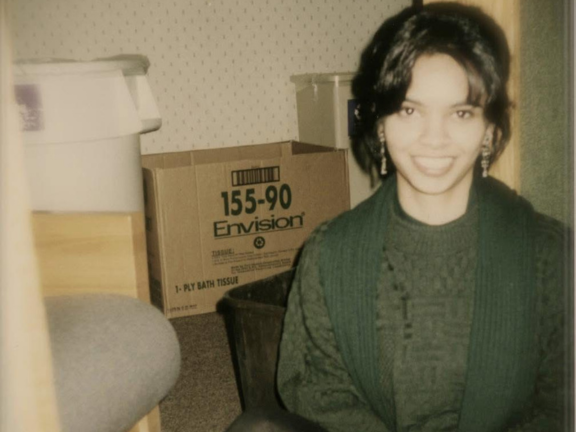
How does your work contribute to or reimagine AAPI visibility, storytelling, or liberation?
I'm skeptical of visibility as an end in itself. A body can be seen and still be misread — still be flattened into a symbol, a demographic, a redemption arc. What I'm more interested in is honesty. The harder, slower, less photogenic kind.
My work tries to tell the truth about what it costs to live an implicated life — to be an immigrant who loves her adopted country and is also responsible for what that country does in the world. To be South Asian and Muslim and American all at once, in a moment when all three of those identities are under pressure. I don't think that story gets told enough, and I don't think it gets told without discomfort.
What feels important to uplift right now is the idea that liberation isn't only about being seen — it's about being free enough to be complicated. To carry grief and accountability and tenderness and rage in the same body, and to make art out of all of it without apology.
What is a piece of advice you'd offer to emerging artists of color working at the intersection of art and social change?
Trust the form. The way you break a line, the way you let a sentence stay unresolved — that is political. You don't have to announce your politics for the work to be doing political work. Let the structure carry what the content can't always say.
Don't write toward the institution. Write toward the person who needed this work to exist and couldn't find it — the younger version of yourself, the friend who called after midnight, the stranger at the reading who stayed after to tell you what the poem did to them. That person is your real audience. Stay loyal to them even when the institutional voice gets loud.
Finish things — and then edit them, ruthlessly and without mercy. That second part is the harder discipline. Fresh work feels alive and fragile, and the instinct is to protect it from the cutting. But real editing requires time, distance, perspective — the willingness to return to the work as a stranger and ask what it actually needs, not what you wanted it to be. That patience with your own work is not a betrayal of the original impulse. It is the fullest act of faith in it.
What words, gratitude, or intentions do you want to offer to the generations who came before you?
I want to say: I know what leaving cost. I know I carry you imperfectly — in words I am losing, in gestures I can't fully describe anymore, in the way I sometimes can't answer a question in the language it was meant to be answered in. I am trying to mourn that honestly, which is its own form of keeping faith.
To the people who farmed land that was taken from them, who grew what they were told to grow, who paid in blood for someone else's wealth and beauty — I see the line from there to here. I am still learning what I owe.
To the women who came before me who made things anyway — quietly, without permission, between the other demands on their lives — I am here because you were. I try to remember that when finishing feels hard.
What projects are you working on currently and how can we support you?
This summer, I'll have an installation and performance as part of ArtPhilly, a festival in Philadelphia marking the 250th anniversary of the United States. The installation at Twelve Gates Arts is a participatory language piece — visitors are invited to respond to open prompts on the wall, to leave something behind, to take something with them. It's about what we do with language in uncertain times. If you're in Philadelphia, please come and add your voice to it.
I just finished editing my full poetry manuscript that I've been living inside for several years now — work about embodiment, climate, migration, what it means to be naturalized into a country and a crisis at the same time. I would like to access the right kind of small press for this work that I hope can reach a broader audience someday. Not being part of any established writing scene, with a demanding job as a lawyer, and having moved around in the last couple of years, it is hard for me to figure out the right publisher for this work. But, I know they are out there. I just need for our paths to cross, as the work will speak for itself. I want the work to make its way to people who need it the most yet don’t know that they do.